- The credit market has moved CoreWeave into distress pricing even as revenue doubles and its backlog reaches US$104bn. The question is not demand. It is the cost, and the repetition, of the capital needed to serve it.
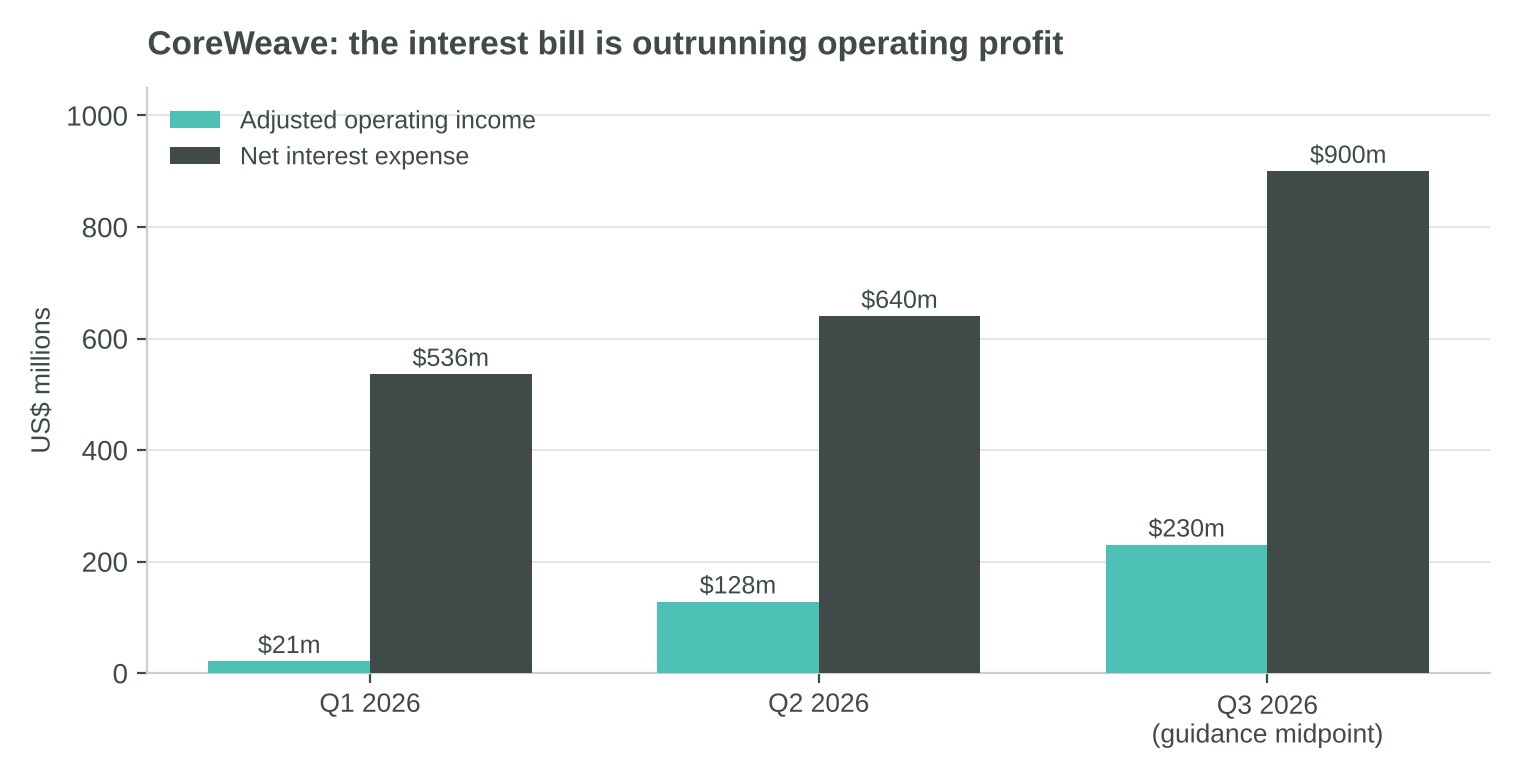
- GPUs are a five-year asset financed on a corporate balance sheet that must re-equip before it has finished paying for the last fleet. CoreWeave's quarterly interest bill now runs at around four times its adjusted operating income.
- CoreWeave is the most leveraged neocloud, not the only one. Peers are on the same curve a few years behind. The only parts of the stack the market prices well are those separated from the corporate balance sheet, which points to a different financing model.
From Firmus to CoreWeave
Last week we examined the withdrawal of Firmus' A$7.1bn ASX float two weeks before its planned debut, and argued that the AI industry needs partner balance sheets to own the compute and power assets that hyperscalers and model labs would rather rent than build. This week we turn to the market leader. If Firmus showed what happens when equity investors decline to fund the neocloud model at a premium, CoreWeave shows what happens when credit investors begin to question it at scale.
CoreWeave is the benchmark neocloud. It listed in March 2025 at US$40 a share, rents Nvidia GPU capacity to Microsoft, Meta, OpenAI and Anthropic, and reported a revenue backlog of around US$104bn at 30 June. Second-quarter revenue rose 112% to US$2.6bn, and management raised full-year guidance to US$12.4-13.2bn. By any operational measure, this is a business growing into extraordinary demand. Yet over the past fortnight the market has started to price its debt as distressed.
What the Credit Market Is Saying
On 13 October, venture investor Chamath Palihapitiya circulated a chart showing CoreWeave's 9.625% unsecured notes due 2032 touching a 15% yield. The next day the shares fell 15.5% to US$65.78, their largest one-day fall since February, on more than three times average volume. By Thursday the five-year credit default swap (CDS) spread had traded as high as 1,194.5 basis points intraday, a record, before settling near 1,088 bp. According to S&P Global Market Intelligence data, that is roughly a third wider than a week earlier and close to three times wider than a year ago.
A CDS is insurance against default. The spread is the annual premium, in basis points, to protect a given amount of debt for five years. S&P Global's Gavan Nolan noted that spreads of 1,000 bp or more are generally read as a sign of credit distress. Market models translate CoreWeave's level into an implied five-year default probability of around 60%. We would not take that figure literally: single-name CDS markets are thin, and implied probabilities move heavily with recovery assumptions. But the direction is clear, and the bond market agrees, with the 2032 notes falling below 80 cents on the dollar.
Three things arrived at once. First, the macro backdrop turned. The Federal Reserve raised rates in September for the first time since 2023, to 3.75-4.00%; the US 10-year yield sat near 5.17% at the end of September; and hotter-than-expected September inflation data on 14 October revived the prospect of a second hike. Second, on the same day, Gartner forecast that more than 80% of neocloud providers will cease independent operations by 2030. Third, CoreWeave has kept returning to market, most recently with an at-the-market programme for up to 35 million new shares alongside a US$3bn convertible note offering due 2033.
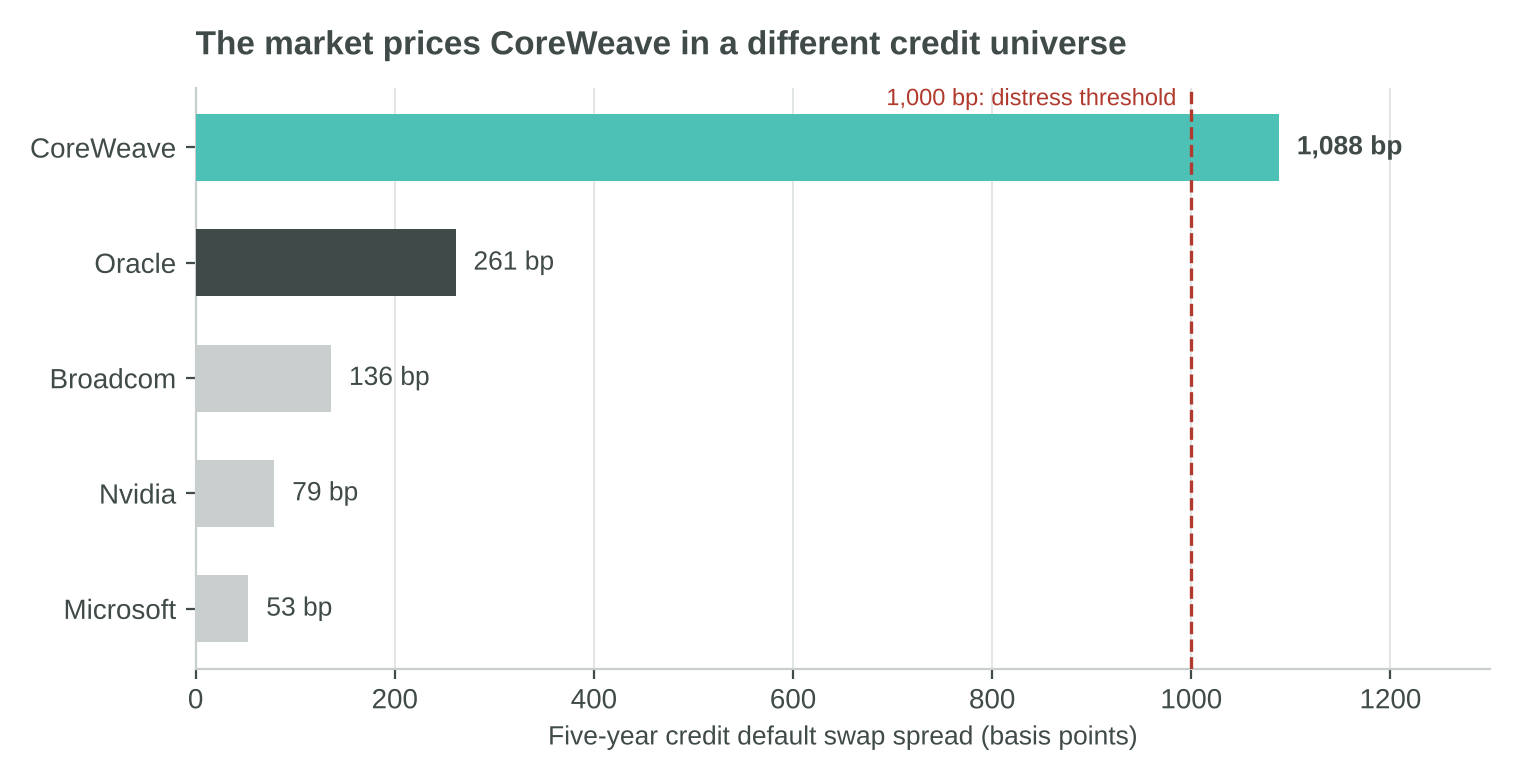
The comparison matters. Oracle, the most stretched of the investment-grade AI borrowers, was cut to BBB- by S&P in July and trades near 260 bp. CoreWeave, rated B+ and therefore sub-investment grade, sits more than four times wider. Big Tech CDS has also widened to record levels this year, so this is a repricing of AI credit across the sector, with CoreWeave at its sharp end.
The Cost of the Chip
The CoreWeave debate is usually framed as demand against debt. We think it is better framed as the cost of compute over time. The second quarter illustrates the point. Adjusted EBITDA was US$1.5bn, a 59% margin. Adjusted operating income was only US$128m, a 5% margin. The gap between those two figures is overwhelmingly depreciation, the accounting charge for GPUs and servers wearing out. Below that line sat net interest expense of US$640m, up from US$267m a year earlier, producing a net loss of US$626m. In effect, the quarter's loss was the interest bill.
Guidance points the same way. For the third quarter, CoreWeave expects interest expense of US$860-940m against adjusted operating income of US$200-260m, with capital expenditure of a further US$11.5-13.5bn. Full-year capex is guided at US$35-39bn. At 30 June the company held US$5.5bn of unrestricted cash against US$35.6bn of borrowings, and around US$52bn of debt and lease obligations combined. Consensus compiled by Visible Alpha, as reported by the Financial Times, has free cash flow at roughly minus US$25bn this year, minus US$28bn in 2027 and minus US$18bn in 2028.
Five Years, Then Start Again
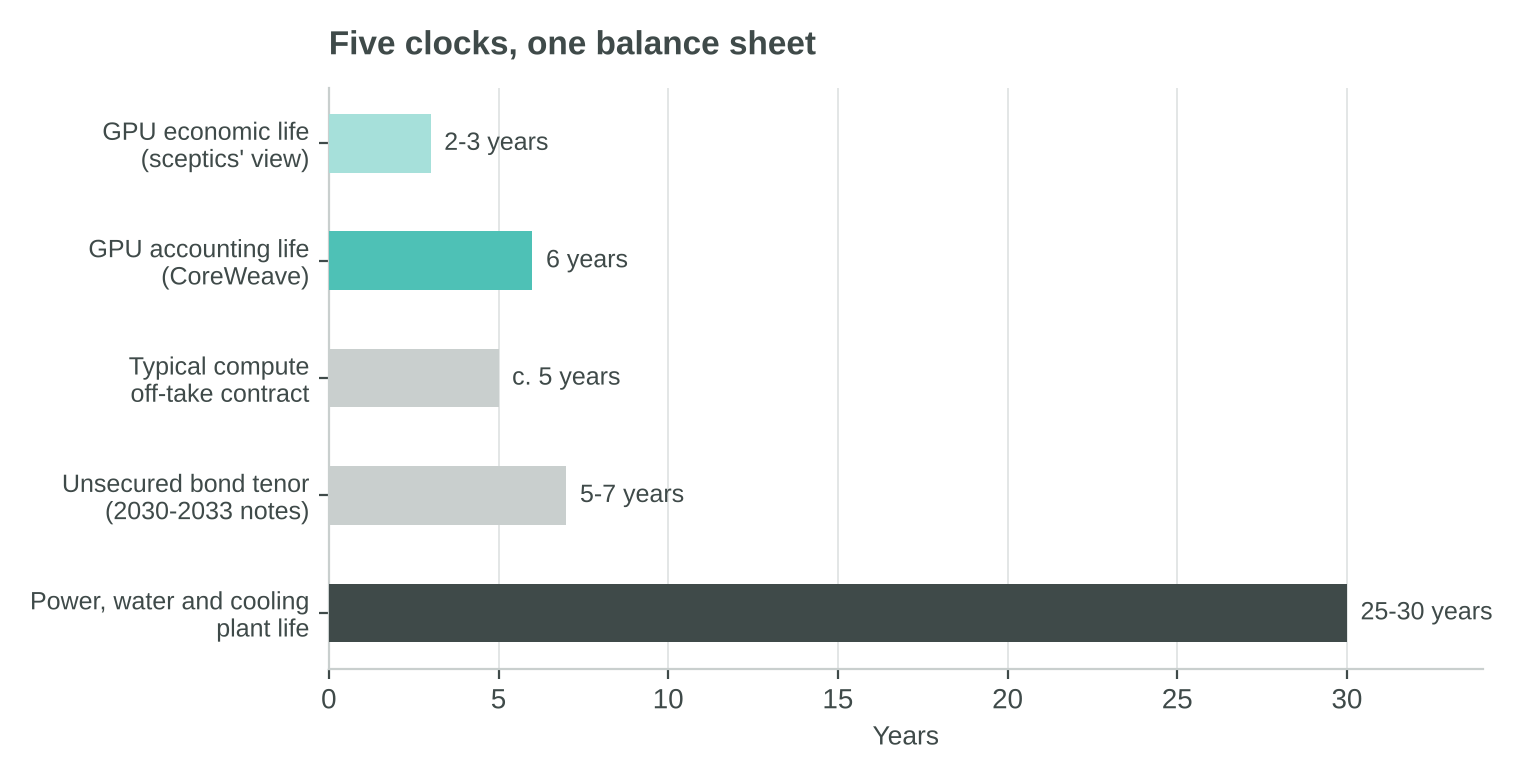
CoreWeave depreciates its GPUs on a straight line over six years, a life it extended from four years in January 2023, before it listed. The hyperscalers also use five to six years, although Amazon has trimmed part of its fleet back to five. Among neoclouds, Lambda uses five years and Nebius moved from four to five this year. Sceptics, most prominently investor Michael Burry, argue that the true economic life of a frontier accelerator is closer to two or three years given Nvidia's annual product cadence, and that the industry will understate depreciation by around US$176bn across 2026 to 2028. Defenders point to a value cascade, in which chips move from frontier training to inference and then to batch workloads, still earning in years four to six.
Both may be partly right. McKinsey's analysis of neocloud economics suggests a GPU hour can lose around half its value over a five-year horizon, and that utilisation below roughly 80% can flatten returns. But the debate over useful life obscures the more important point. Whatever the accounting life, the fleet must be replaced, broadly every five years, and each new generation costs more per unit than the last. As an illustration, a fleet with US$100bn of installed cost on a five-year life implies around US$20bn a year of replacement spending simply to stand still, before a single megawatt of growth is funded.
Five Clocks, One Balance Sheet
The deeper problem is that a neocloud combines assets and liabilities that run on different clocks. GPUs are depreciated over six years and may earn frontier rates for fewer. Customer contracts typically run around five years. Unsecured bonds mature in five to seven. The power, cooling and water plant that keeps a data centre running lasts 25 to 30 years. CreditSights' Jordan Chalfin has flagged the risk directly: if the industry overbuilds, customers have little reason to renew at expiry, while the lease obligations behind the capacity run on. Funding all of this through a single corporate entity means the longest-lived, most bankable assets carry a cost of capital set by the shortest-lived, riskiest ones.
Is CoreWeave Typical?
CoreWeave is the most leveraged of the listed neoclouds, but it is not an outlier in direction. The table below sets out the reported positions of its peers.
| Company | Reported debt (30 June 2026) | Position |
|---|---|---|
| CoreWeave | US$35.6bn borrowings (c. US$52bn incl. leases); US$5.5bn cash | S&P B+. 2026 capex guidance US$35-39bn. Unsecured 2032 notes near 15%. CDS above 1,000 bp. |
| Nebius | US$8.55bn debt; c. US$8.0bn cash | Minimal net debt today, funded by equity and convertibles. Consensus net debt c. US$14bn by end-2026 and c. US$34bn by end-2027. |
| IREN | US$7.59bn debt; US$5.9bn cash | FY26 impairments of US$639m and a net loss of US$703m. Some GPU financing at 9%. |
| Hut 8 / TeraWulf | US$7.6bn / c. US$5.7bn | Former bitcoin miners converting to AI hosting, funded with secured and convertible notes. |
| Firmus | US$10bn debt facility (Feb 2026) | A$7.1bn ASX float withdrawn on 9 October. Private round under discussion. See Whose Balance Sheet? |
| Oracle (IG comparator) | c. US$129.5bn total debt | Cut to BBB- by S&P in July. FY26 free cash flow of minus US$23.7bn. CDS near 260 bp. |
Sources: company filings; Yahoo Finance; TIKR; Morningstar; Plugin Capital; Bloomberg. Hut 8 figure is carrying value of loans, notes and other financial liabilities.
Nebius is the clearest counterpoint. Morningstar describes its balance sheet as stronger than its peers', with minimal net debt, because it has used a high share price to raise equity and convertible notes rather than straight debt. Even so, consensus estimates show its net debt climbing to around US$34bn by the end of 2027, above CoreWeave's roughly US$30bn at June. IREN booked impairments of US$639m in its 2026 financial year. Behind several of these companies sits the same supplier as shareholder: Nvidia has invested in CoreWeave, Nebius, Nscale, Firmus, Lambda and others, which helps demand for its chips but adds a circular element to the capital stack.
The market's reaction tells us it is pricing the model, not just the company. When CoreWeave's bonds sold off, Nebius fell 12% in a single session and IREN, Hut 8 and TeraWulf each lost around 10% or more, despite materially different balance sheets. Last week Firmus withdrew its float; this week the question has moved from equity valuation to credit capacity. CoreWeave is simply further along a curve that its peers are now beginning to climb.
What the Commentators Say
The bearish case is now mainstream. Gartner estimates AI providers will spend close to US$1tn on AI infrastructure in 2026 and a further US$6tn between 2027 and 2030, with more than US$3.5tn exposed to impairment by the end of the decade. It does not expect the sector to reach a 12% return on invested capital before 2032 at the earliest. S&P rates CoreWeave's financial risk as aggressive. Davidson analyst Gil Luria has warned that CoreWeave's equity could be worthless if the AI investment cycle reverses, and Freedom Capital Markets' Paul Meeks described its balance sheet as weak relative to neocloud peers. Morningstar cut its price target, citing rising debt costs as hyperscalers compete for the same capital.
The bullish case is about demand and refinancing. Chief executive Michael Intrator told staff the market was acting irrationally, pointing to the backlog, and the company says nearly all of its 2027 capacity is already sold. Nvidia's Jensen Huang said CoreWeave's cost of capital is in fact falling and that Nvidia has no need to backstop it. There is some support for that: CoreWeave has cut its average borrowing cost by almost three percentage points over the past year.
That last point is the most important data point in this story. Co-founder Brannin McBee, who runs CoreWeave's financing, told the Financial Times the company wants investment-grade ratings on more of its chip-backed debt to reach insurance capital, which he described as “unlimited”. The template already exists. In March, CoreWeave closed an US$8.5bn loan secured on its GPUs and a long-term Meta off-take contract, anchored by Blackstone Credit & Insurance and rated A3 by Moody's and A-sf by Fitch. Nebius closed a US$775m facility in July at SOFR plus 2.50%, backed by an investment-grade customer contract. The same company whose unsecured bonds trade near 15% can borrow at single-A when the asset and its contract are ring-fenced. The market is not refusing to fund AI compute. It is refusing to fund it through the corporate balance sheet.
Monard's View
Our view is that the conventional debt-and-equity structure is unsuited to capital expenditure of this scale and replacement cycle. A corporate balance sheet funds assets with a blend of equity and debt, and the leverage it can safely carry is capped by the volatility of the whole enterprise. When the asset base must be replaced every five years, the enterprise never deleverages. Each cycle requires new debt before the last is repaid, and new equity to keep leverage within covenant and rating limits. Shareholders absorb repeated dilution; creditors price the risk that the next raise fails. A programme for up to 35 million new CoreWeave shares running alongside bond yields near 15% is that dynamic in plain view.
Structures built to contain leverage risk and protect equity value will therefore cap investment well short of the level AI requires. The four largest hyperscalers alone guided to around US$725bn of capital expenditure this year, and Gartner sees US$6tn more by 2030. No plausible combination of neocloud equity and high-yield debt funds that. The constraint is not appetite for AI; it is the shape of the balance sheet being asked to carry it.
A different financing model is needed, and the market has already shown us its outline: separate the clocks. Long-life power, water and cooling plant should be owned in bankruptcy-remote vehicles against take-or-pay contracts with investment-grade off-takers, and funded with investment-grade asset-backed securities over 20 years or more. GPUs should be financed on amortising, contract-matched, chip-backed facilities that run off with the off-take. The operator then carries a smaller, cleaner equity base exposed to the risk it is best placed to manage: running compute.
This is the structure Monard uses to fund energy infrastructure. We own behind-the-meter power and water assets on a low-leverage, securitised basis, contracted to data centre developers. We do not lend to neoclouds. Our role is to remove the 25 to 30 year layer from the data centre developer's balance sheet, which opens a deep, stable pool of fixed income capital, rather than another leveraged equity story competing for the same high-yield dollar.
We believe Monard should now consider extending the same structure to compute through chip rental. Under this model, a dedicated bankruptcy-remote vehicle acquires GPU fleets and rents them to chip manufacturers' customers under long-term agreements, with each fleet funded on its own amortising, contract-matched basis rather than through an operator's corporate balance sheet. The manufacturer records the chip sale, the customer receives fully funded compute at scale without raising corporate debt or equity, and the five-year replacement cycle is financed fleet by fleet, separated from the 25 to 30 year power and water layer. This is ownership, not lending: Monard would hold the asset and its contract. Together, chip rental and behind-the-meter power and water would give the industry one securitised source of capital for both clocks.
So, What's Around the Corner?
Four signals will tell us whether the credit market's verdict hardens or eases over the next quarter.
- CoreWeave's third-quarter results, expected in November. Management has guided interest of US$860-940m against adjusted operating income of US$200-260m. The gap between those two lines is the single number the credit market is watching.
- The Federal Reserve's 27-28 October meeting. A second hike would lift floating-rate costs and raise the refinancing hurdle for every leveraged neocloud at once.
- Rating agency treatment of AI lab contracts. CoreWeave concedes that off-take contracts with non-investment-grade labs cannot yet reach insurance capital. If agencies extend investment-grade treatment to them, the asset-level model scales. If not, the corporate balance sheet stays the funding channel of last resort.
- Peer balance sheets turning from equity to debt. Nebius and others have so far leaned on equity and convertibles. Consensus has that changing in 2027. Watch whether they borrow at the corporate level or at the asset level.
The question is no longer whether AI demand is real. It is whether the capital structure financing it can survive its own replacement cycle. We think the answer lies in separating the assets, not in adding more leverage.
Daniel Blizzard | Managing Partner and Founder, Monard Infrastructure Inc.
Contact: Nadia Lotter | nadia.lotter@monardinfrastructure.com
This publication is provided for general information purposes only and does not constitute financial, investment, legal or tax advice. It does not take into account the objectives, financial situation or needs of any particular person. Forward-looking statements, forecasts and market-implied measures referred to in this document are based on current expectations and third-party data, are subject to significant uncertainty, and actual outcomes may differ materially. Credit default swap levels and implied default probabilities are indicative market measures, not forecasts. References to companies are for illustration and are not recommendations.
Sources: CoreWeave Q1 and Q2 2026 results and earnings calls; CNBC (14 and 15 October 2026); S&P Global Market Intelligence; Financial Times (14 October 2026) via Dealroom; Yahoo Finance (14-16 October 2026); Forbes (15 October 2026); Gartner press release (14 October 2026); Morningstar via Stocktwits (16 October 2026); TIKR (September and October 2026); Plugin Capital, The Global Neocloud Top 20 (September 2026); SiliconANGLE / theCUBE Research (November 2025); Nebius Group Form 6-K filings (2026); Bloomberg and FT reporting on Oracle and Big Tech CDS (July-October 2026); Reuters on the Federal Reserve (September 2026); McKinsey, Neoclouds' challenges and next moves.